The Still Point of the Turning World
I’m in a church filled with spiraling music. A dervish whirls in turning devotion to the ecstatic strains of Qawwali. The un-ordinariness of the present moment helps me remember what is always there, but which is so easily washed away by the unrelenting stream of life. As I stand in candlelight beneath the majestic rose window, I am no longer my thoughts, not my feelings, not my sensations. Once again, I am All. The next moment I notice a talisman: the Seal of Solomon.

The symbol struck me because it’s not usually associated with Islam, but with Judaism: the Star of David. The ceremony I was attending is part of the practice of Sufism, the esoteric teaching that lies at the heart of Islam. But here, the six-pointed star was not a symbol of a people or a nation, but a powerful key to a living spiritual practice.
In this time of global dissonance – especially the seemingly eternal conflict in the Middle East – the familiar image of the six-pointed star beckoned me closer. Could it be that this symbol, held in common by two apparently divergent traditions, was not a point of contention, but a map of reconciliation?
The six-pointed star is a universal emblem known as the Seal of Solomon, which represents spiritual self-mastery. It stands for the union of opposites and the alchemical transformation of the coarse into the fine. Beyond its talismanic use, it functions as a blueprint of initiation, and reveals the pattern within the soul of anyone walking towards self-mastery, unity, and awakened presence.
It reveals the geometry behind the divine order of the cosmos.
Archetypal Meaning
The Seal consists of two interlaced triangles encoding the Hermetic axiom: “As above, so below”: one ascending, indicating prayer, the aspiration to evolve and grow; one descending, indicating mercy and grace, perpetually flowing from above.
In Kabbalistic (esoteric Judaism), alchemical, and Sufi traditions alike, this interweaving of the higher and the lower expresses the reconciliation of polarities, such as:
- Masculine and feminine
- Light and shadow
- Heaven and earth
- Human and divine
The hexagram is a symbol of synthesis that reminds us that the work of the student is not to escape the world, but to remain within it and make it sacred.
The Alchemical Seal
In alchemy, this is the sign of the Philosopher’s Stone: unified essence. The seal represents the state where opposing elements no longer resist one another, and merge into a greater whole. To manifest the Seal within is to carry out the inner work of the esoteric traditions.
This is not merely symbolic. The inner alchemist experiences the seal as the crystallisation of previously disparate parts of the psyche – an embodied geometry of selfhood forged by the transmutation of suffering. This leads to the emergence of Will, and the capacity to transform whatever arises into the gold of awakening.
The Geometry of Creation
The hexagram is also a cosmic diagram, indicating the six directions: North, South, East, West, Above, Below, as well as a central point: the Axis Mundi. It has twelve edges, echoing zodiacal and cosmic correspondences, and seven points (six vertices plus the center), aligning with the seven planets, and the seven energetic centres that we in the west are most familiar with as chakras.
The hexagram is an example of sacred geometry – the hidden architecture that underlies all of creation. It reflects the human as a microcosm of the macrocosm, and the world as a mirror of divine order. The Seal is a Mandala of Balance.
To meditate on the Seal is to contemplate one’s place within an intelligent, living cosmos.
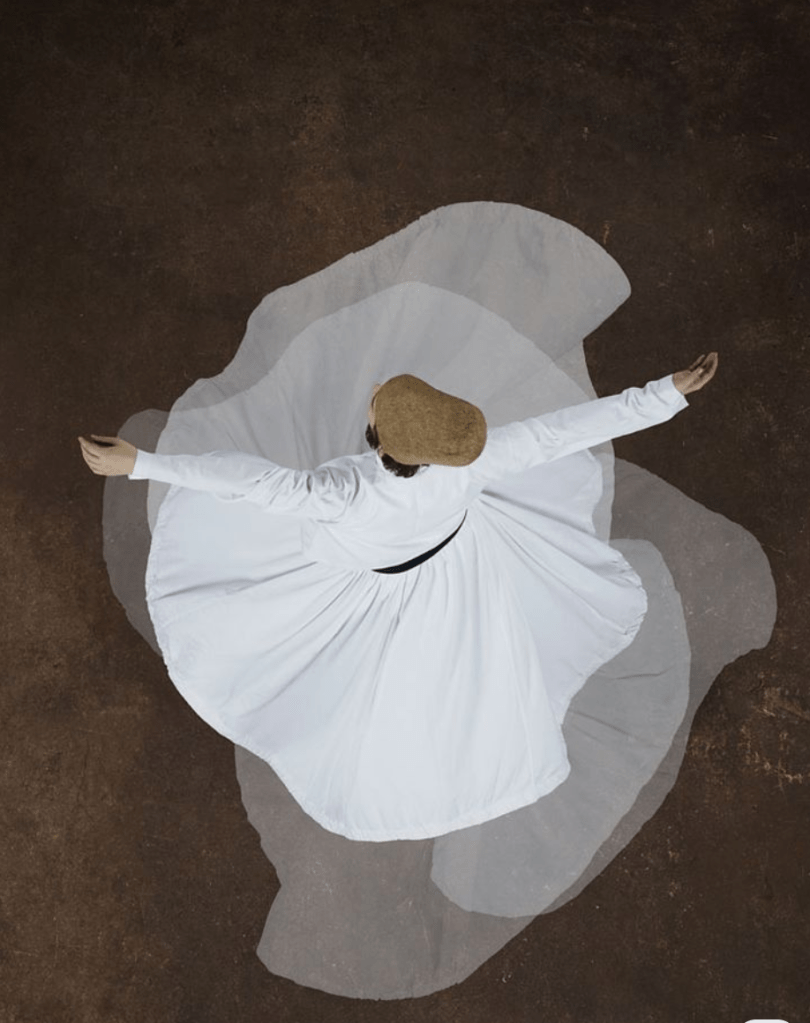
The Whirling Dervish
To witness the entrancing turning of a dervish is to experience a living mandala. Rooted in the Mevlevi Sufi tradition, the dervish whirls as a sacred act of remembrance (dhikr). Each rotation is a movement towards the Divine.
The dervish spins with his right hand raised to receive divine grace, and the left hand turned downward, transmitting that grace back to the earth and all its beings. In this state, he becomes a conduit between heaven and earth, a living axis mundi. His heart is the pivot, his body a compass.
He embodies the cosmic rhythms of the planet’s revolution on its own axis, the turning of the seasons, the phases of the moon, the precession of the equinoxes, and the dance of atoms. The dervish reenacts the celestial motion in human form: As above, so below. This is not a performance, but active participation in the All: Abiding Presence.
And paradoxically, the spinning generates profound stillness, both in the practitioner and onlooker. As the body whirls, the mind quiets. A trance state arises, and we enter the altered consciousness of deep meditation. Like a birthing woman who surrenders fully to the waves of labor, the dervish rides the cosmic spiral, not to control it, but to be reborn. The ego dissolves and the adept becomes the eye of the storm: The still point of the turning world.
King Solomon
In both Jewish and Islamic traditions, Solomon is more than a historical figure. He is the archetype of the Adept, Disciple or Student. He is the one who builds the inner temple, or esoteric spiritual core of being, surrounded by the outer, exoteric forces of life. He commands without domination, through wisdom, integrating the disparate parts of the self into a single unified whole, attaining self-mastery. His name means Peace.
The ring of Solomon – the Seal itself – is the mark of one who has harmonized the four elemental energies within, integrated all aspects of his being, and aligned his will with the Divine. In both mystical Judaism and Sufism, the Seal is the signature of spiritual authority born out of humility.
For the Sufi, Solomon is not just a king, but a realized human being. He is Perfected Man, whose purity and devotion allow him to transcend language. His ability to speak to animals and spirits is symbolic of complete harmony with the cosmos. Sufi masters like Ibn Arabi interpreted the seal as a mirror polished by remembrance that reflected the Real.
The Seal is both a symbol of just rulership and a gateway to esoteric truth, revealed only through purification, devotion, and the surrender of the ego (nafs).

For the Kabbalist, Solomon is the builder of the inner temple where heaven and earth meet. It represents the power of the righteous king to align with God’s will. In Jewish legend, Solomon was given a ring by God, engraved with a sacred name or symbol, the Tetragrammaton – YHWH. With it, he could control demons and jinn, speak the language of animals, build the Temple with the help of supernatural beings, and discern truth from falsehood.
The Star of David reflects the unification of heaven and earth, a key theme in Jewish mystical thought. Solomon is the mystic adept – a man whose wisdom gives him access to higher realms. The Seal is interpreted as a symbol of Tiferet, the divine emanation of harmony, balance, and divine beauty that links the higher and lower worlds. It also represents the mystical union of the divine masculine and feminine (Tiferet and Shekhinah) whose sacred marriage sustains creation.
Both traditions show that the Seal is more than a mere legend or myth. It is a living glyph that continues to guide the inner journey of Seekers of the Truth today.
Toward a Deeper Unity
In an age of increasing polarization, the Seal of Solomon reminds us that all true traditions speak of the same wholeness, not fragmented sides of an argument. The upward and downward triangles are not in opposition to each other. They are the necessary parts for transformational wholeness. This is the miracle that arises at the centre.
Seeing this symbol while listening to Qawwali in a Christian church, I was offered quiet, urgent guidance: unity is present in our midst. In a moment when Islam and Judaism seem tragically divided, I was invited to look into the symbols they both revere, the wisdom they share, and the mystical paths that run beneath the dogma and doctrine.
The Seal of Solomon is not the property of one people or culture. It is the emblem of the initiated human being. One who reciprocates, reconciles differences, and emanates love. One who lives in alignment with the deeper order behind appearances.
In this, the Seal becomes a universal prayer:
“Here there are neither Russians nor English, Jews nor Christians, but only those who pursue one aim – to be able to be.” – Gurdjieff aphorism
Welcome to the Skeleton Key.
Do you have a question for The Skeleton Key?
Your message has been sent

 The Skeleton Key
Leave a comment