The Enneagram is not what most of us have been led to believe.
It is not a catalogue of types.
It is a living map of the cosmos.
At first glance, it appears as a simple nine-pointed star enclosed within a circle.
Yet within it lies a roadmap of becoming that reveals how every undertaking begins, gathers force, and ultimately falters. And also how, with the right impulse provided at the right time, any venture, however large or small, can be brought to completion.
The Enneagram shows us how to do.
It reveals not what we are, but how things happen in life, in nature, and within ourselves.

History of the Enneagram
The Enneagram was drawn and first taught by G. I. Gurdjieff in the early twentieth century.
Gurdjieff introduced it to his students in Moscow and Paris between 1916 and 1923 as a way of expressing universal principles that govern all processes: the Law of Three and the Law of Seven.
He hinted that he had encountered it during his travels in Central Asia and the Near East, though no verifiable record of any specific manuscript or school has ever been found.
Some scholars have seen a resonance with Sufi cosmology, Jewish Kabbalah (particularly the flow of the sefirot), and Pythagorean number mysticism, yet none of these traditions contain a nine-pointed symbol joined by the same lines.
After Gurdjieff’s death in 1949, his students such as P. D. Ouspensky, A. R. Orage, John Bennett, and Maurice Nicoll explored its implications for psychology, cosmology, and inner work.
In the 1960s and 1970s, Oscar Ichazo and Claudio Naranjo adapted the figure to describe nine ego-fixations. This is the framework from which today’s Enneagram of Personality emerged.

But long before corporate seminars colour-coded the mysterious diagram, it was taught as a working symbol in esoteric schools. Beneath the psychological interpretations lies its original language: Number.
Long before it became a map of types, the Enneagram was a mathematical mandala that encodes order, energy and vibration. Its nine points are centres of gravity where energies congeal, shift, or evolve.
The Recurring Sequence
When 1 is divided by 7, the result is the endlessly repeating decimal 0.142857142857… This closed cycle of six digits, 1-4-2-8-5-7, recurs indefinitely without ever touching 3, 6, or 9.
When this sequence is plotted on a circle numbered one through nine, it traces the six-pointed inner web of the Enneagram.
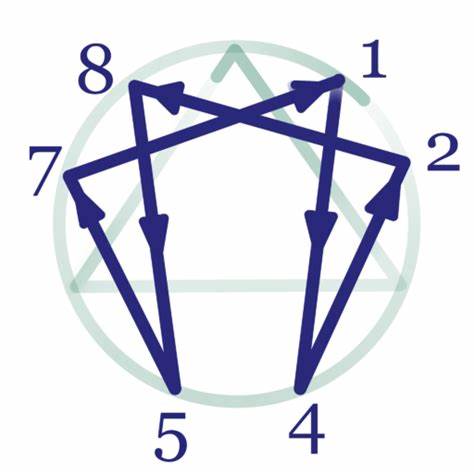
The sequence shows how energy moves through any process, whether the musical scale, the growth of a plant, the unfolding of human life, or spiritual ascension.
It teaches that no process unfolds in a straight line given the physical and metaphysical laws under which we live. Each unfolding moves through lulls, deviations, and inflection points. The missing numbers in the sequence 1-4-2-8-5-7 marks the intervals. These are moments when any given process deviates from its original intention, or, more rarely, receives an influx of energy and stays on course.
Laws of the Enneagram
The Enneagram unites the fundamental cosmic laws the Law of Seven and the Law of Three in a single symbol.
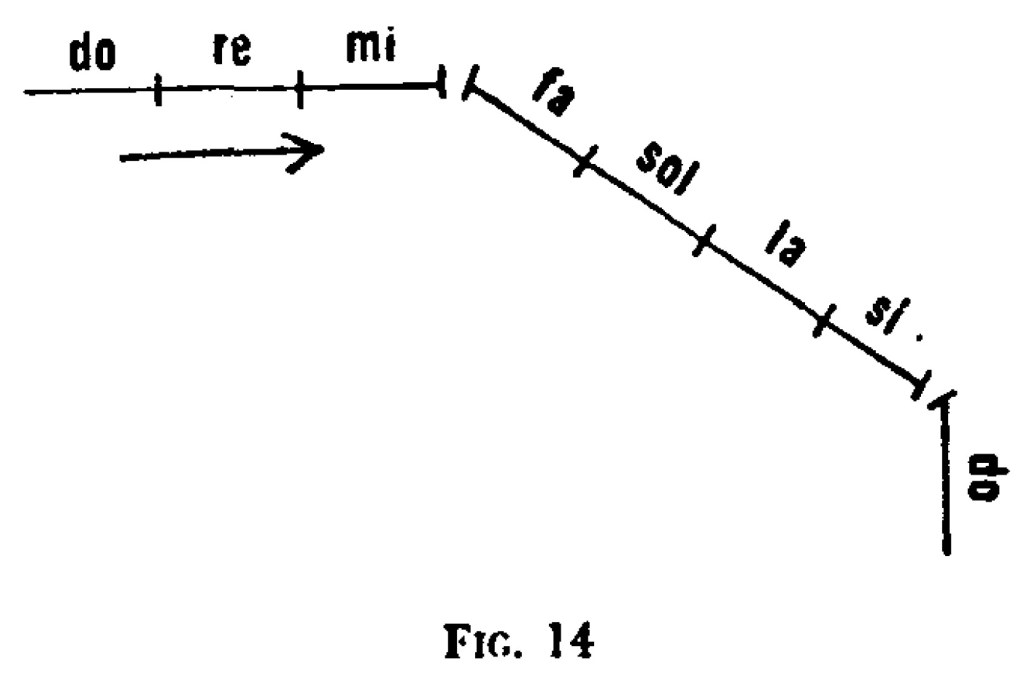
The Law of Seven, which is embedded in the musical octave, shows that every process proceeds through seven distinct steps. At specific points, these are intercepted by intervals that require conscious energy to enter in order for growth to continue. Nine marks the point of return to the beginning – the rebirth of the cycle, the next octave.
In Western music, the diatonic scale – Do–Re–Mi–Fa–Sol–La–Si–Do – spans an octave, the interval between one note and the next with double its frequency. Within that octave, the steps are not equal. The pattern is:
Tone–Tone–Semitone–Tone–Tone–Tone–Semitone
or in simple terms:
1–1–½–1–1–1–½
These two semitones, between Mi and Fa and Si and Do, are narrower intervals, points of tension or instability where the melody naturally leans forward, seeking resolution. If you hum a scale, you’ll feel it: Mi seems to ask for Fa, and Si longs for Do. They are thresholds — places where momentum falters and something extra must enter.

Gurdjieff views this musical fact as an expression of a cosmic law. Every process moves through an octave: it begins with an impulse (Do) and rises through successive stages, but at certain points (Mi–Fa, Si–Do) the force weakens. Unless an additional impulse, what Gurdjieff called a shock, enters, the process cannot cross the gap. Just as a musician’s breath or bow carries a phrase through a semitone, so conscious effort must appear at these intervals for any action, project, or inner work to reach completion.
So, the semitones are places where nature pauses.
Without conscious energy, the process can’t cross the gap; it will either stall or slide sideways into a lower octave, or into a disharmonic deviation. But if the “shock” arrives the octave completes, reaching the higher Do, a full doubling of frequency, which now begins the next cycle at a higher pitch.
Gurdjieff’s Law of Seven shows that every creative act, every transformation, unfolds through a rhythmic series, not a straight line. The semitones are thresholds – subtle, demanding, and crucial for harmonic presence.
The Law of Three introduces the triadic forces of active, passive, reconciling to the circle and the Law of Seven. These are the forces that make creation possible.

The progression is not automatic; at certain intervals – points 3 and 6 (on the Enneagram’s circle) – the vibration falters. To continue, a new conscious energy must be introduced. Without such “shocks”, the process inevitably weakens, deviates, or fragments.
Sometimes, an external event can supply this energy by accident, giving the illusion of self-driven progress. But in reality, doing arises only when the shock is introduced consciously as an act of will. This is the foundation of Gurdjieff’s Enneagram teaching: the ability to bring the right force at the right time.
When such shocks are consciously applied, the octave continues in an ascending flow, eventually reaching completion. Without such shocks, the process drifts or collapses into its own opposite.
This explains why so many of our projects stall, resolutions fade, and why ordinary efforts so often fail.
Lacking unified will – a single “I” – we are buffeted by conflicting aims and reactions, unable to supply the inner energy that sustains an intention through lawful resistance.
Together, the Law of Seven and the Law of Three embody a complete geometry of transformation; the key to understanding how all cosmic processes manifest.
The Enneagram maps how any process – in nature, in life, or within ourselves – unfolds in the dimension of time.
It is a diagram of change.
To bring any aim to fruition, we must fill the lawful intervals that occur with attention, will, and conscious energy.
This is no abstract theory. It is a material law, as real as gravity.
Everything that happens in life arises from what has gone before: our conscious and unconscious actions, behaviours, and attitudes. In this sense, our being – the sum of all that we are – attracts our life.
This truth has been diluted in popular culture as the Law of Attraction.
Yet what such simplifications overlook is that, in our ordinary state, man cannot do. We cannot simply will an outcome, because we are divided within ourselves, driven by competing currents.
Instead, we adjust our aims after the fact, sustaining the illusion of control while drifting from our original course.
But every process – from baking bread to raising a child to the birth of a star – follows a bending, rhythmic flow punctuated by intervals that need to be bridged to remain on course.
The Enneagram teaches us to anticipate these intervals, and to meet them consciously.
In the next part, we’ll turn from the cosmic to the human; from the law of process to the essences it shapes.
Welcome to The Skeleton Key.
Do you have a question for The Skeleton Key?
Your message has been sent

 The Skeleton Key
Leave a reply to A LETTER FROM A READER – The Skeleton Key Cancel reply